
Minnesota Traffic Court Records
Minnesota traffic court records are public documents filed with the District Court in each county where a citation was issued. You can search for traffic cases online through the state's free court records system, pay fines through the centralized payment portal, or visit your local courthouse in person. This guide covers how to find, access, and understand traffic court records across all 87 Minnesota counties.
Minnesota Traffic Court Records Overview
How to Search Minnesota Traffic Court Records
The Minnesota Court Records Online system, known as MCRO, is the state's free public access portal for court records. It launched in March 2021 and covers District Courts in all 87 counties. You can search traffic court records by case number, citation number, party name, or attorney. The system shows party names, case status, hearing dates, and filed documents. There is no charge to search or view records through MCRO, and you don't need to create an account.
One important thing to understand: pre-conviction traffic cases are not available online through MCRO. If your case is still open and a conviction hasn't been entered, you have to visit the courthouse to view those records. Under Minnesota Rules of Public Access Rule 8, subdivision 2, not all courthouse-accessible records are available remotely. Post-conviction traffic records, including major and minor criminal cases, are available through the online system. The database updates hourly throughout the business day.
The Minnesota Judicial Branch homepage at mncourts.gov serves as the main entry point for all court services in the state. You can find court locations, check calendars, access MCRO, and get general legal help all from one place. Minnesota's court system runs on a three-tier structure: District Courts handle all traffic cases at the trial level, the Court of Appeals handles appeals, and the Minnesota Supreme Court sits at the top. All traffic cases start and are usually resolved at the District Court level.
The Minnesota Judicial Branch website is the main portal for all court services across the state.
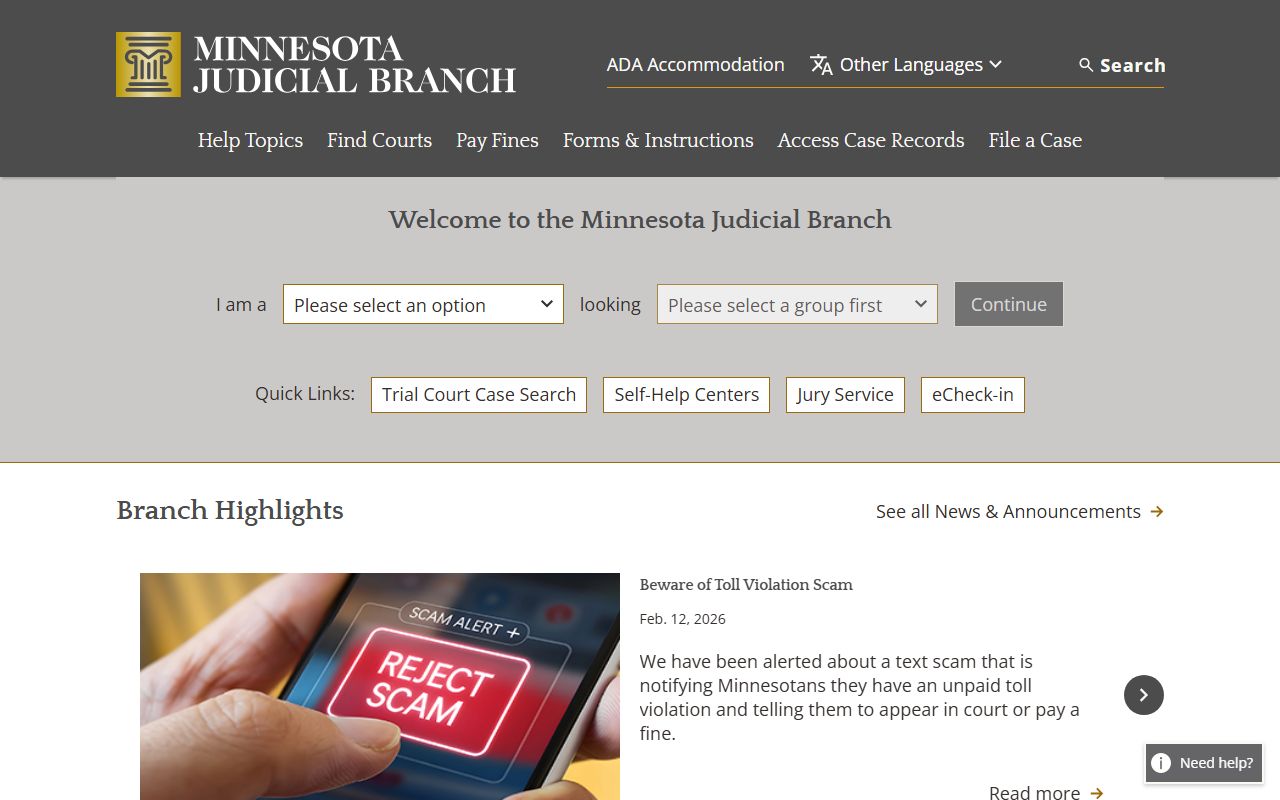
Use mncourts.gov to find courts, check calendars, or access the court records search system for any county in the state.
To search for Minnesota traffic court records online, go to publicaccess.courts.state.mn.us. The system offers four types of searches: Case Search, Document Search, Hearing Search, and Judgment Search. For traffic matters, the Case Search option works best. You can search by name or citation number. Street addresses for parties are not shown online for privacy reasons. Documents are typically available within 24 hours of filing. The system is down for maintenance on Sundays from 9:00 a.m. to 4:00 p.m.
The MCRO search portal lets you look up Minnesota traffic court cases statewide.
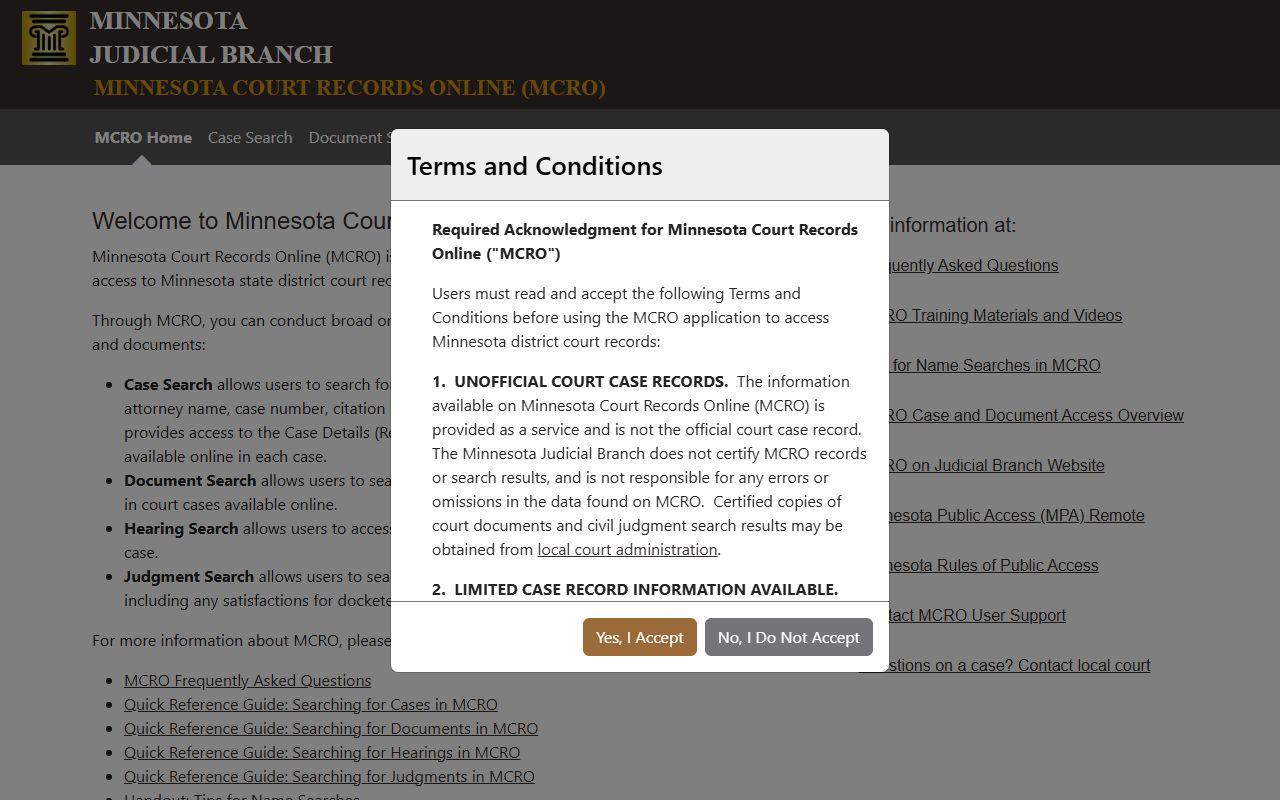
Visit publicaccess.courts.state.mn.us to search traffic court records by name, case number, or citation number across all 87 counties.
Paying a Minnesota Traffic Citation
You have four ways to pay a traffic fine in Minnesota. Online payment through the web portal is the fastest option. Phone payment works during business hours. Mail lets you pay by check without leaving home. In-person payment at the courthouse works on regular business days. All methods are centralized through the Minnesota Court Payment Center. They handle citations for all 87 counties statewide.
The online payment portal is available at webpay.courts.state.mn.us. It is open 24 hours a day except during scheduled maintenance on Sundays from 1:00 p.m. to 5:00 p.m. You'll need your citation number or court file number to look up your case. There is a $2.34 convenience fee for online and phone payments, charged by Heartland Payment Systems under Minnesota Statute 480.237. Mail payments to Minnesota Court Payment Center, P.O. Box 898, Willmar, MN 56201 have no added fee. Do not send cash by mail.
Allow up to 7 days from the date your citation was issued before you try to pay online. It can take up to 20 days for a citation to appear in the payment system. You have 30 days from when the citation is entered into court records to respond or pay. If you have a "no proof of insurance" citation and you were actually insured at the time, do not pay the fine online first. Submit proof of coverage to the Court Payment Center by fax at 320-231-6507 within 30 days of filing.
The Minnesota Court Payment Center web portal handles traffic fines for all 87 counties.
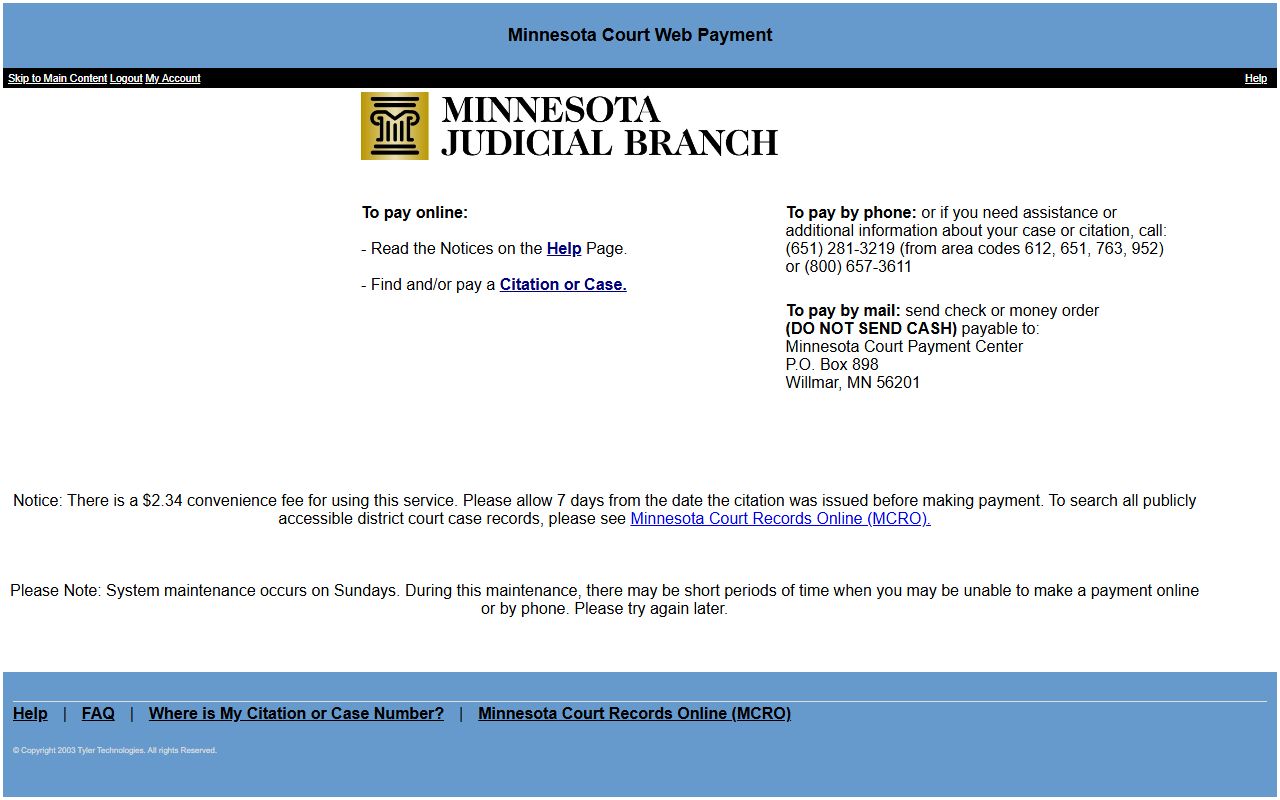
Pay your traffic citation at webpay.courts.state.mn.us or by phone at (651) 281-3219 (metro) or (800) 657-3611 (toll-free).
The pay a fine page at mncourts.gov covers all payment options in detail. If you can't afford to pay in full, you can call the Court Payment Center to ask about a payment plan. Some courts also allow community service in place of fines for people with financial hardship. If a case has gone to collections, contact the Minnesota Department of Revenue at 1-800-657-3909. Partial payments are accepted online, but your case stays open until the full balance is cleared.
The pay a fine information page at mncourts.gov covers every payment option available in Minnesota.
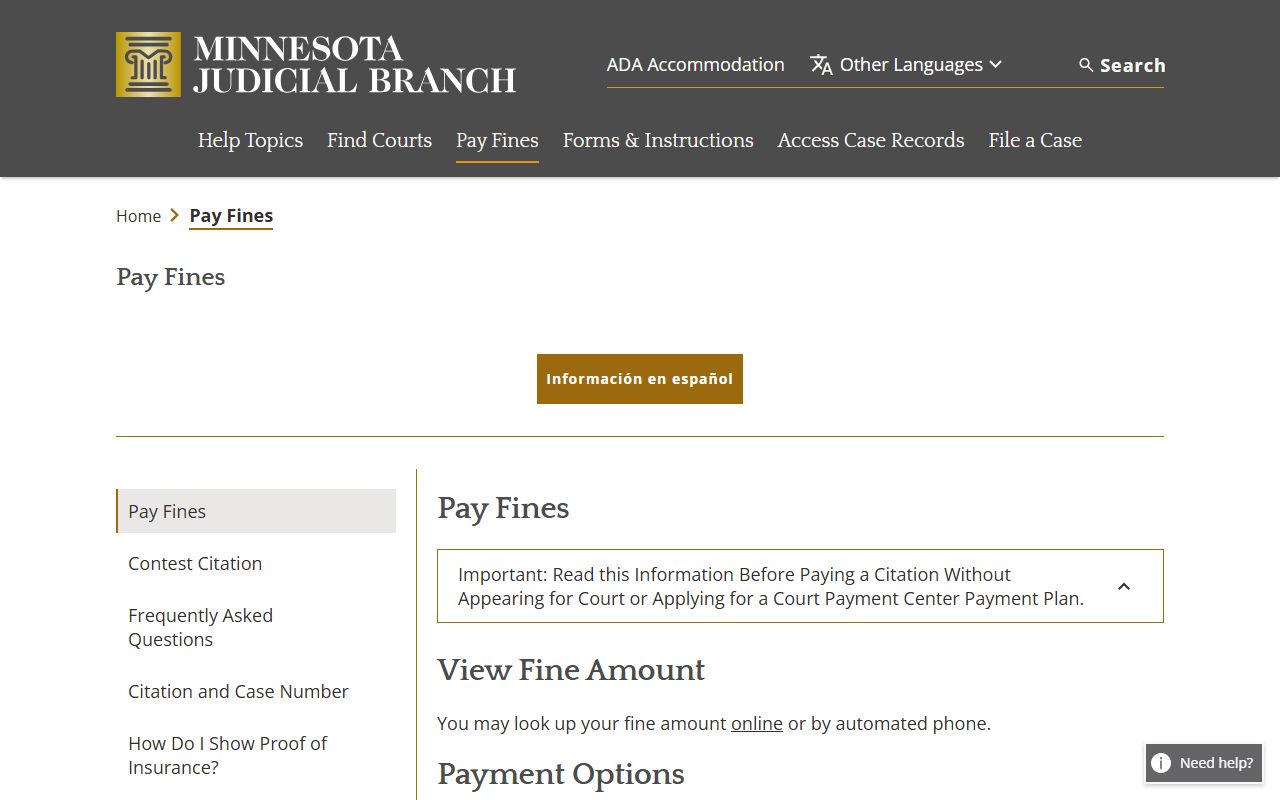
For a full breakdown of payment options, visit mncourts.gov/pay-a-fine or call the Court Payment Center during business hours.
Your Options After a Traffic Citation
When you get a traffic ticket in Minnesota, you have four main choices: pay the citation, contest it, submit proof of insurance (if that's the charge), or reopen a case that was already decided. Paying the fine counts as a guilty plea. It means a conviction goes on your record. If you want to fight the ticket, you need to request a hearing. The process depends on your county.
Seven Minnesota counties have Hearing Officers who can resolve payable traffic citations without a judge: Anoka, Carver, Dakota, Hennepin, Ramsey, Scott, and Washington. A Hearing Officer can offer you a reduced fine, a payment plan, or a continuance for dismissal with payment of prosecution costs. To schedule a Hearing Officer appointment, call the Court Payment Center at (651) 281-3219. You can attend in person, by video, or by phone. If you and the Hearing Officer can't reach a deal, a court date may be set.
The traffic issues help page at mncourts.gov explains all options for handling a citation in Minnesota.
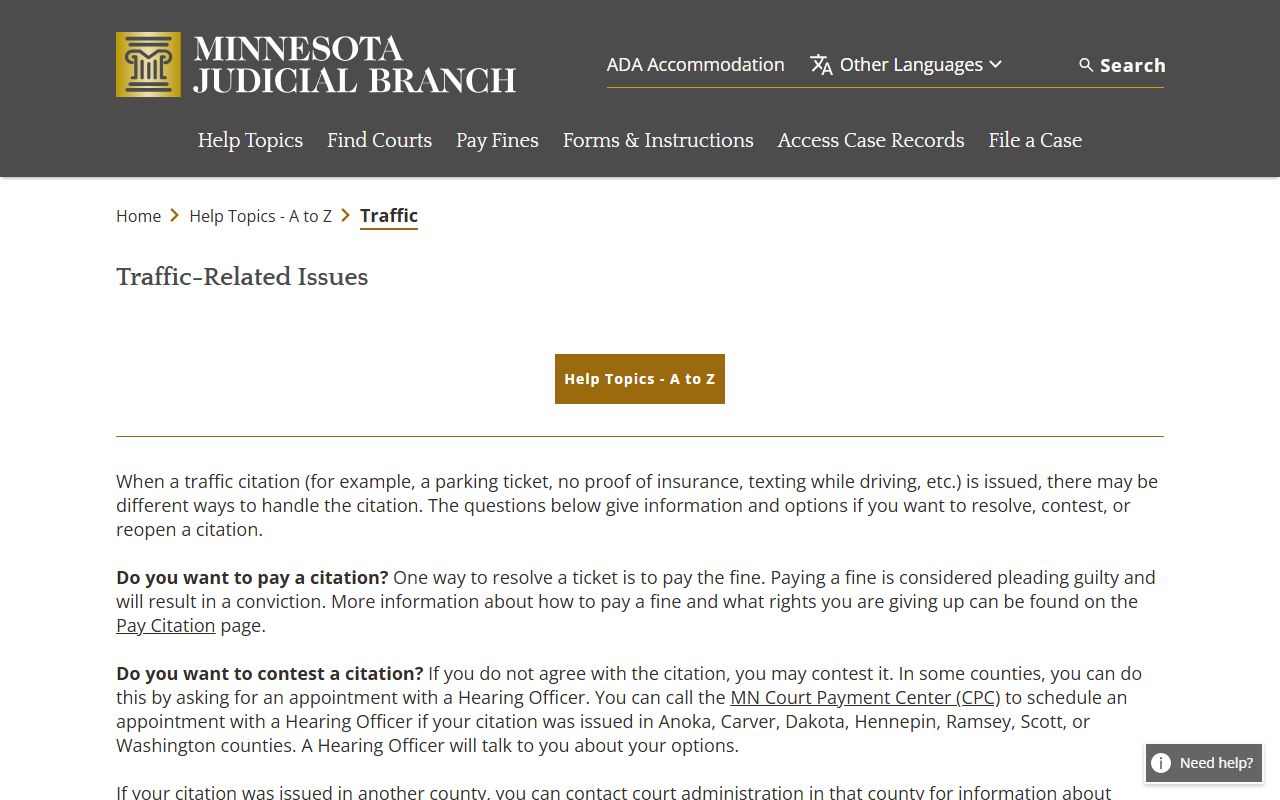
Visit mncourts.gov/help-topics/traffic-issues for step-by-step guidance on contesting citations, submitting insurance proof, and reopening past cases.
For counties without Hearing Officers, you contact the District Court directly to ask about contesting a citation. The process usually involves requesting a court date and appearing before a judge. If you miss your court date or fail to pay within 30 days, a warrant may issue, your license could be suspended, and late fees will add up. Reopening a closed case requires filing a Motion to Withdraw Guilty Plea. This is allowed under specific circumstances, including cases where you didn't appear, paid without fully understanding your rights, or entered a continuance that later became a conviction.
Minnesota Traffic Laws and Penalties
Minnesota traffic law uses four levels of offenses under Minnesota Statute 169.89. Petty misdemeanors carry fines up to $300 with no jail time. Misdemeanors can mean up to 90 days in jail and a $1,000 fine. Gross misdemeanors go up to one year and $3,000. Felony-level traffic offenses carry more than a year in prison. Most common moving violations fall in the petty misdemeanor category, though serious violations move up quickly.
Speeding law is set out in Minnesota Statute 169.14. The statute sets base speed limits: 30 mph in urban districts, 55 mph on other roads, 65 mph on non-interstate expressways, 70 mph on rural interstates, and 10 mph in alleys. Speeding more than 20 mph over the limit adds a surcharge equal to the fine amount, minimum $25. Driving over 100 mph results in automatic 6-month license revocation. School zone and work zone speeding both trigger their own surcharges. Speed cameras became active in certain areas on August 1, 2025, with a $40 fine for standard violations and $80 for violations 20 or more mph over the limit. First offense through a camera is a warning only.
Reckless and careless driving fall under Minnesota Statute 169.13. Reckless driving means conscious disregard for safety and is a misdemeanor. Careless driving means operating in a way that endangers people or property. Common examples include unsafe lane changes, tailgating, and failing to yield. Texting while driving is banned under Minnesota Statute 169.475 and is a primary offense, meaning police can stop you solely for that reason. The fine is typically in the $135 to $140 range before fees. Seat belts are required for all occupants under Minnesota Statute 169.686.
The Minnesota Revisor of Statutes site shows the full text of Minnesota speeding laws including radar enforcement rules.
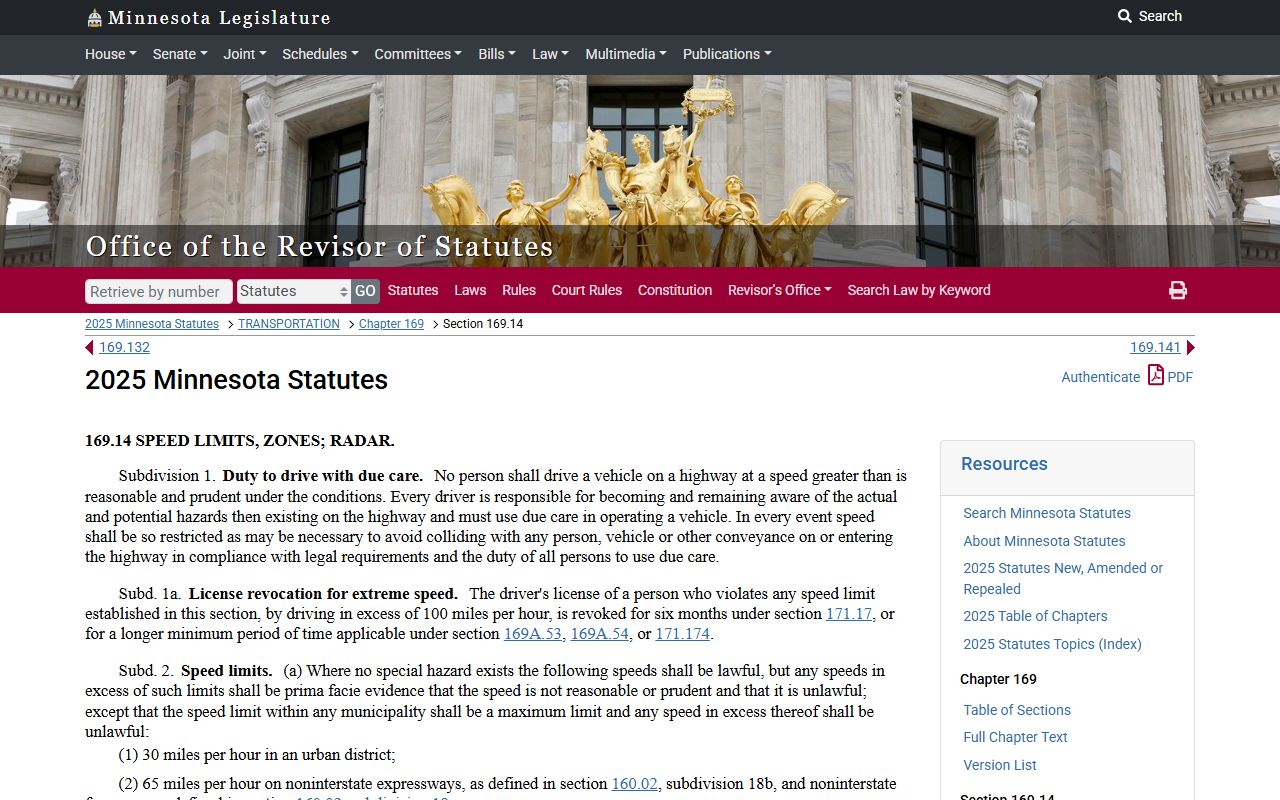
Read the full text of Minnesota traffic laws at the Minnesota Revisor of Statutes.
Minnesota Driver Records
Traffic convictions in Minnesota go on your driving record. The state does not use a point system like many other states. Instead, Minnesota tracks the number of convictions over set time periods. Four offenses in 12 months trigger a 30-day suspension. Five offenses in 12 months bring a 90-day suspension. Eight or more offenses in 24 months can mean a one-year suspension. Serious violations like driving over 100 mph result in immediate revocation regardless of prior offenses.
One carve-out worth knowing: the Dimler Amendment keeps minor speeding violations off your record in certain situations. If you were driving under 10 mph over the limit in a 55 mph zone, or under 5 mph over in a 60 mph zone, the conviction may not appear on your record. This is specific to those speed thresholds and doesn't apply to school or work zones.
You can request your driving record from the Driver and Vehicle Services division of the Minnesota Department of Public Safety. A non-certified copy costs $9. A certified copy is $10. You'll need to fill out Form PS2502. Mail requests go to: Driver and Vehicle Services, Attn: Records Unit, 445 Minnesota St., Suite 161, St. Paul, MN 55101-5161. You can also request records in person at the Town Square Building, 445 Minnesota St., Suite 190, St. Paul. The phone number for the Records Unit is (651) 296-2940.
The DVS records request procedure page explains how to obtain your Minnesota driving record.
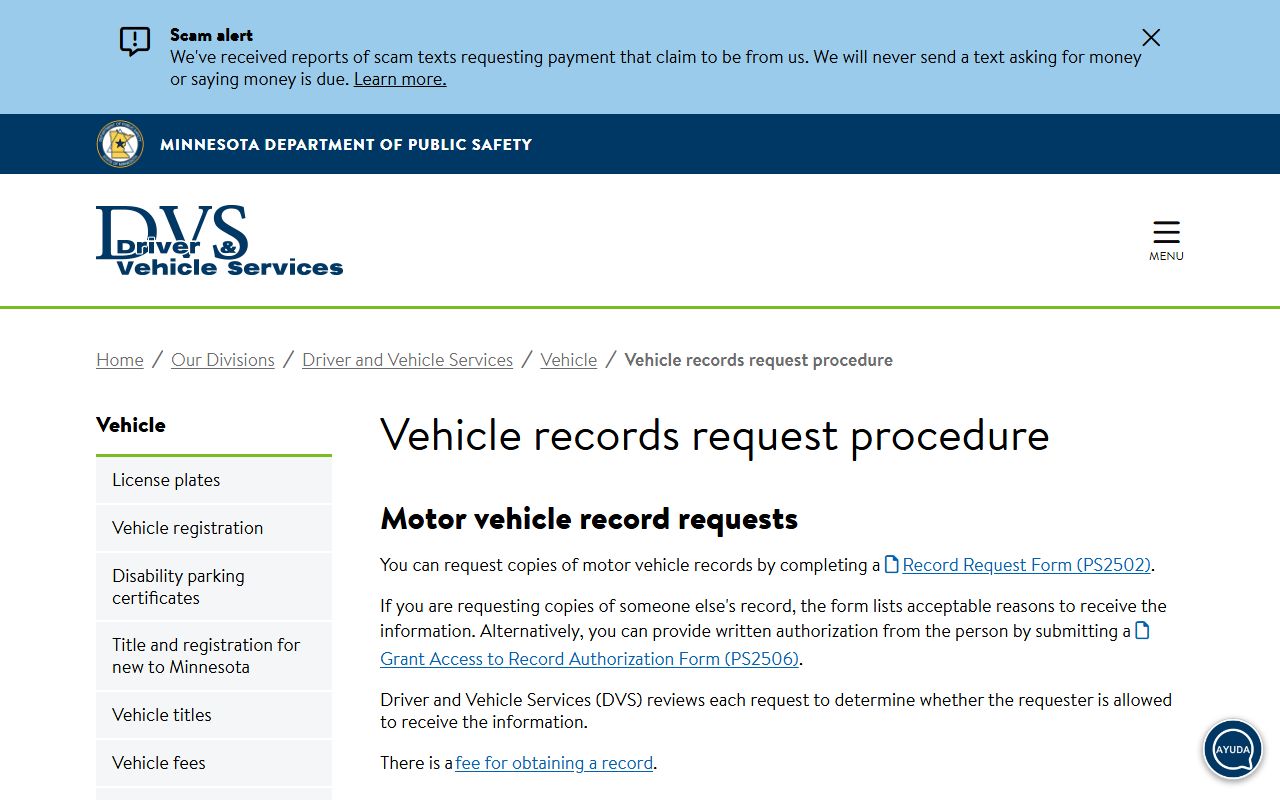
Learn how to request your Minnesota driving record at dps.mn.gov. The reinstatement fee after a suspension is $30 under a 2021 law change.
Find Your Minnesota Court Location
Minnesota has 87 county District Courts organized into 10 judicial districts. Every county has at least one courthouse handling traffic cases. Some large counties have multiple locations. St. Louis County has three separate courthouses in Duluth, Hibbing, and Virginia. Dakota County has its main courthouse in Hastings plus service centers in Apple Valley and West St. Paul. Hennepin County has four locations in the Minneapolis area.
Most courts are open Monday through Friday from 8:00 a.m. to 4:30 p.m. Some counties have different Wednesday hours. Olmsted County opens at 9:00 a.m. on Wednesdays. Payments are generally not accepted at the counter after 2:30 p.m. on the last working day of each month. Use the online or phone payment system on those days. Courts post daily calendars as searchable PDFs at 7:00 a.m. and update them hourly. Calendars are also available at the courthouse.
The Minnesota courts directory shows all 87 county courts with contact info and hours.
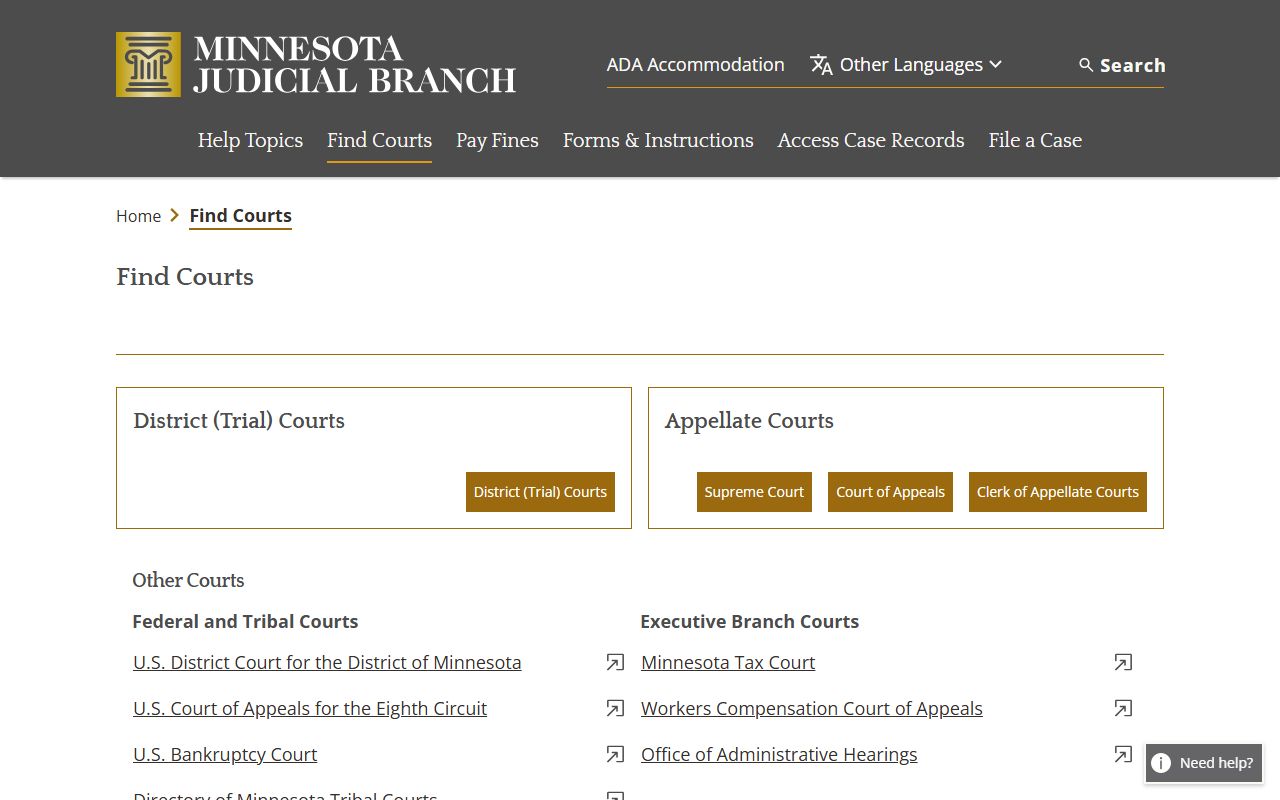
Find your local courthouse at mncourts.gov/find-courts. The directory lists phone numbers, addresses, and parking details for every county in the state.
Hearing Officers are available in select counties to resolve tickets without a full court hearing. The Anoka County Hearing Officer program is one example of how this works across the metro area.
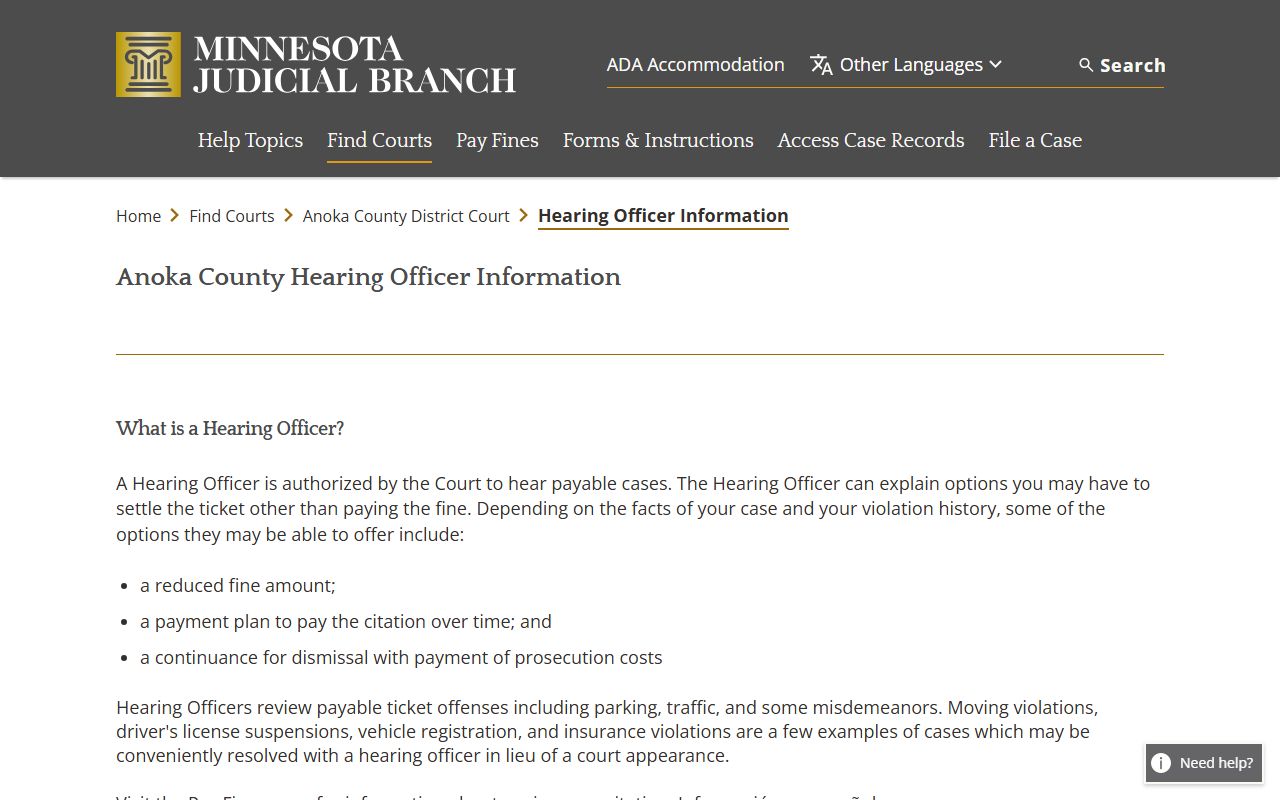
Learn more about the hearing officer program at mncourts.gov/find-courts/anoka/hearing-officer-information. Hearing Officers can reduce fines, set payment plans, or offer continuance for dismissal.
If you are not represented by a lawyer, the Minnesota Self-Help Center network offers free legal information about traffic cases. You can reach self-help services by phone at (651) 435-6535 on Monday through Friday from 8:30 a.m. to 4:00 p.m. Legal kiosks at more than 250 locations across the state also provide access to court resources. ADA accommodations are available at all courthouses upon request. Language interpreter services are offered for non-English speakers.
Driving after your license has been suspended, revoked, or cancelled is a criminal offense under Minnesota Statute 171.24. A first offense is a misdemeanor. Subsequent offenses are gross misdemeanors. Fines typically start around $278 for a first violation and go up from there.
Browse Minnesota Traffic Court Records by County
Each of Minnesota's 87 counties has its own District Court handling traffic cases. Select a county to find local court contact info, payment options, and case search resources.
View All 87 Minnesota Counties
Traffic Court Records in Minnesota Cities
Traffic cases filed in a city are handled by the District Court in that county. Select a city to find local court details, payment resources, and record access information.